06 June 2013

Just Like Tomorrow


Few cities in the world are as glamorous or heavily romanticized as Paris, with millions of tourists flocking to the city every year. It is truly a magical place, unless of course you are one of the millions of poor Parisians living in cramped, high-rise apartments known as estates. Faiza Guène’s novel Just Like Tomorrow is about Doria, the daughter of Moroccan immigrants who have come to Paris in hopes of making a better life. As if struggling to survive in a new and foreign country is not difficult enough, Doria’s father abandons her and her mother to fend for themselves, making their situation that much more dire. Despite this, Doria offers the reader a lighthearted glimpse at the struggles of those who are unable to afford the finer things in life.
 

Through Doria, Guène offers the reader a glimpse at the unfortunate situation that millions of other people in Paris and around the world find themselves in. Unable to survive in their native lands due to a history of exploitation and poverty, they are forced to move to those centers of power in the hope of a better life. In the case of Doria, though, it is often just as difficult to survive in this new home. With her dad gone, it is just her and her mother, who does not even speak French. Doria struggles in school, wears second-hand clothes that are mocked by her peers, and struggles with the feelings of worthlessness that often come with poverty, only compounded by the abandonment by her father. For Doria, her life is one long stretch, where today is the same as yesterday and tomorrow will not be any different. Doria cynically and wittily observes her austere life and the people in it – institutions, neighbors, social workers, bosses, and teachers. Her power of observation is one of the few things Doria actually has to call her own and, as a result, few are safe from the sharpness of it.
 

While the book is a piece of fiction, the author and main character have many similarities. Guène is the daughter of Algerian immigrants and also grew up in the suburbs of Paris. Her own experiences give the book a sense of authenticity because she has possibly shared many of the same experiences as Doria, or knows someone who has. This increases the chances that the story is a true representation of the people and the culture – that the view of Parisian immigrants like Doria is not taken from a place of power but rather from someone who has first-hand experience and knowledge.
 

The sole failure of this book is its lack of a cohesive storyline. Doria’s experiences are amusing and interesting, but Guène fails to turn it into any kind of organized plot that keeps the reader hooked. I enjoyed it merely from a cultural perspective, not sure if other readers will have the patience for it.
 

.....

For more books similar to Just Like Tomorrow, check out:

Pigeon English by Stephen Kelman
The House on Mango Street by Sandra Cisneros
Dreams From the Endz by Faiza Guène
 
.....
 
Here is an interview with the author by The Observer from around the time the book was first released.


.....

More information on the plight of immigrants living in the French suburbs can be found here.


.....

The following video looks at life in French suburbs, much like the one Doria lives in, and explores how complicated the issues surrounding these suburbs are. 


.....

And on a somewhat unrelated note, here is the trailer for The Intouchables, which is one of my favorite movies. One of the main characters is from the French suburbs as well, so you get another glimpse at the conditions Doria lives in. Rated R.


30 May 2013

In Darkness

In a country where some people think bad things happen to others because of the religion they practice, it is more important than ever to have proper perspective in order to empathize and make informed decisions. The novel In Darkness by Nick Lake tells the story of a poor, gangster boy in Haiti trapped by the rubble from a massive earthquake. At the same time, there is a parallel storyline happening with Toussaint l’Ouverture, leader of the Haitian slave rebellion against the French.

The portrayal of Haitian people and culture in this novel relies heavily on many of the darker, more sinister sides of the island. Living in Site Solè, one of the poorest, most dangerous slums in the world, the main character Shorty experiences extreme poverty, brutal murders, drugs, and overall hopelessness. By the age of 12, he has killed a man and watched his father be hacked to pieces by a machete. This extremely grim representation of Haitian life is balanced by connecting Shorty to Toussaint l’Ouverture, with the book switching back and forth between the two. Toussaint’s story is not particularly cheery either – he sees his fair share of human suffering and injustice, such as when a slave owner has one woman’s baby killed in front of her because she tried to smuggle it out of slavery. Despite these horrors, Toussaint provides an element of perspective for the rest of the story. The reader sees events of the past, such as the cruelty of Europeans towards slaves, which have lead to Haiti’s present condition. It is unclear whether or not Lake’s portrayal of some of the more negative aspects of Haitian people and culture are a true representation. Regardless, he also shows the unfair treatment and exploitation of the Haitian people throughout history, which have contributed to many of the current problems.

Though he is writing about Haiti as an outsider, an Englishman, Lake’s view of the culture is not taken from a place of power. Not only is the book critical of the slave owners and European colonists of the past, but also of the UN soldiers and workers in the present day. Shorty’s slum is blocked by UN soldiers in an attempt to keep the poverty and violence contained, meaning that the people living there are left to starve and struggle for their own survival with no hope of ever escaping their dismal situation. Shorty’s entrapment in the rubble from the earthquake echoes the jail cell he and countless others have faced in Site Solè on a daily basis.

Despite what some American preachers might declare, extreme poverty and earthquakes in Haiti are not a result of voodoo. For every catastrophic human action, there is a history. This book gives readers the history and perspective that they might not get otherwise, which is very valuable, whether or not it is an entirely factual representation of present-day Haiti.

.....

For more books similar to In Darkness, check out:
Taste of Salt: A Story of Modern Haiti by Frances Temple
Behind the Mountains by Edwidge Danticat
.....

Here  is an interesting interview with the author about the book.  Followed by this somewhat more whimsical Q&A with the author, in which he reveals "U-Mass" by Pixies is one of his favorite songs - so he's pretty cool.

.....

Information on gangs and why some people, like Shorty, join gangs.

.....

A documentary discussing with Haitians the conditions of Haiti and showing some of the positive work being done in Haiti by Haitians.


.....

These  are some first-hand accounts of the devastating Haitian earthquake from the hours and days after it happened.

.....

And finally, a comprehensive reading guide for the novel.

23 May 2013

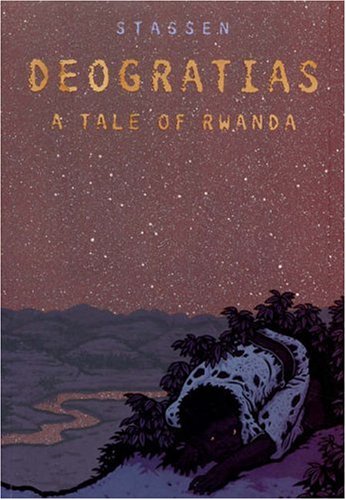
Deogratias: A Tale of Rwanda

In his graphic novel Deogrotias: A Tale of Rwanda, Jean-Philippe Stassen portrays the life of a young, Rwandan man name Deogratias and his experiences before, during, and after the Rwandan genocide. The story is not told in a normal linear timeline, but rather through flashbacks – creating a feeling of schizophrenia and regret. The novel brutally shows how Deogratias is forced to kill people of another ethnicity, including the girl that he loves and how he then transforms into a dog. This is representative of the way he is treated by others and also how he feels.

The Rwandan genocide is an example of mankind failing miserably. Though Stassen is Belgian and the novel is written from an outside perspective, it is not an unfair portrayal of the situation by any means. Stassen paints the Rwandan people and their culture at its worst, yes, but he does the same for the rest of the world. He shows how the Europeans, Americans, and United Nations are all complicit in these atrocities. The Europeans, through their colonialism, set up the conditions in Rwanda for the genocide to happen and the rest of the world sat by as it actually happened.

Stassen depicts every possible type of person in this novel: the victims, the murderers, those struggling to make a better life for themselves and their families, Europeans helping people, Europeans taking advantage of people, and those forced to kill against their will.

The novel is a difficult read for readers of any age, given the subject matter, but an important one nonetheless. We must be aware of such atrocities and understand why they happen in hopes of preventing them from ever happening again. For young adults, this novel presents the genocide in a form they can digest, through pictures, without skimping on any of the important issues. It teaches all of us that bad things do not happen in isolation, but rather they have causes and effects. It also raises the complexities for why such things happen. How many other Hutus, like Deogratias, only killed Tutsis for fear of being killed by their own kind?

Though not a Rwandan, Stassen humanizes the millions of victims and perpetrators in the Rwandan genocide, calling for all his readers to care.

.....

For more books similar to Deogratias, check out:
Maus by Art Spiegelman
Over a Thousand Hills I Walk With You by Hanna Jansen
They Poured Fire on Us From the Sky: The True Story of Three Lost Boys from Sudan by Benjamin Ajak, Benson Deng, Alephonsian Deng, and Judy Bernstein.

.....

Here is a brief biography on Jean-Philippe Stassen.  Though I was able to find some interviews with him, they were all in French.

.....

This article describes the awful situation for children during and after the Rwandan genocide, the hundreds of thousands of orphans left to fend for themselves.

.....

The following excerpt from the excellent documentary "Do Scars Ever Fade?" covers the historical conditions that allowed for the Rwandan genocide to happen.

 
.....

View some stunning photos of the Rwandan countryside and genocide survivors.

.....

And finally, a sample lesson plan I found for the novel.

16 May 2013

Let Sleeping Dogs Lie

History is littered with instances of humans inflicting pain on one another. Though there is no comparison to the victims of this suffering, the offspring of the perpetrators, too, pay a high price. In her novel, Let Sleepings Dogs Lie, Mirjam Pressler gives readers the unique perspective of someone whose family was directly involved in the persecution of the Jews in Nazi Germany. Johanna is an eighteen year-old girl living in modern day Germany who struggles to learn the truth of her family’s secretive past. Pressler uses the character Johanna, who, like most teenagers, is trying to figure out who she is as an individual, to explore ideas of justice and responsibility even when someone is not directly involved in causing the tragedy.

While on a school trip to Israel, Johanna is told that her grandfather stole a store from Jews when the Nazis were in power and built the family’s fortune from it. To complicate the situation further, Johanna, after her grandfather commits suicide, inherits a very large sum of money and feels guilty because she has no way of knowing if the money was obtained unjustly. Desperate to learn the truth of her family’s fortune and to appease her conscious, Johanna tries to find out as much as she can, seriously clashing heads with her father in the process. He wants her to leave the rumors in the past and to let sleeping dogs. In the end, though, Johanna learns that her grandfather was a Nazi and profiteer who knowingly benefited from the mistreatment of the Jews. Despite learning the truth, Johanna does not know how to right the wrongs that were committed decades earlier by people who are dead against people who are also dead.

Pressler uses the storyline to illustrate just how complicated and confusing these matters can be. The story switches back and forth between the present, Johanna’s time in Israel, her own mind, and imagined conversations and events. It is at times overwhelming for the reader, mirroring the problematic jumble of Johanna’s own thoughts as she tries to make sense of the terrible information she is slowly and painfully uncovering. On one side she is being told by her father that survival means taking advantage of situations as they present themselves and that, even though what her grandfather did was not necessarily right, it is in the past and nothing can be done about it now. On the other side she has her teacher who, through similar circumstances in her own family, comes to the conclusion that guilt remains guilt, and doesn't go away simply by pretending it isn't there.  This suggests that, although there are some wrongs that can never be fully righted, it does not exempt people from making some attempt to remedy the situation. She goes further to state that sometimes the only recourse we have is to talk about it, because otherwise silence can make us accomplices in the crime.

As a German, it is an interesting issue for Pressler to raise and write about. Through Johanna, she questions what our responsibility as humans is to stop or heal suffering. Although sometimes we may be powerless to stop injustice, past or present, we can always acknowledge that it is happening and speak out about it.

.....

For more books similar to Let Sleeping Dogs Lie, check out:
The Diary of a Young Girl by Anne Frank
Night by Elie Wiesel
The Book Thief by Markus Zusak

.....

Here  is a brief biography about the author.

.....

This is an interesting interview with a German teacher about how the Holocaust is taught in German schools.

.....

This is the trailer for a documentary that looks at the descendents of supporters of the Third Reich, and the guilt and shame that they live with today for acts they themselves didn't commit - tying in perfectly to the subject matter of the novel.


.....

And  finally an article that touches on some of the issues in the book.  As a survivor of the holocaust, one man argues that it is not history, but something that happens today in other forms because everyone has the potential for evil.  Today, as much as ever, it is important to speak out against injustices.